
A practical guide to transmission designs, fluid requirements, compatibility and maintenance
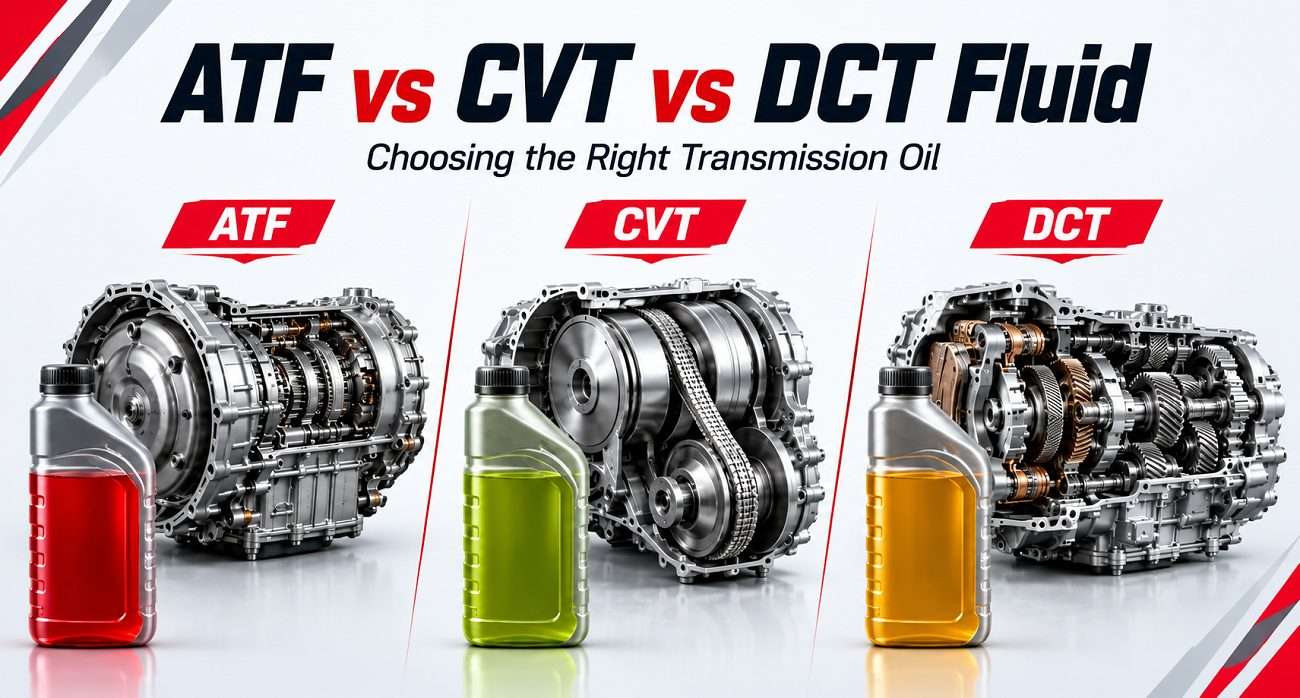
Automatic transmissions may look similar from the driver’s seat, but their internal designs can be very different. A conventional stepped automatic, a continuously variable transmission (CVT) and a dual-clutch transmission (DCT) rely on different mechanisms to transmit power. Their fluid requirements are therefore not necessarily interchangeable.
One distinction matters from the outset: CVT and DCT refer to transmission designs. ATF means automatic transmission fluid and, in everyday workshop language, usually refers to fluids formulated for conventional stepped automatic transmissions. Although the term can sometimes be used broadly, a bottle labelled ATF should never be assumed suitable for a CVT or DCT.
1. How does a conventional automatic transmission work?
A conventional stepped automatic transmission uses a defined set of gear ratios, typically through planetary gearsets, and controls shifts using hydraulic circuits, friction clutches and electronic systems. Many designs use a torque converter to couple the engine to the transmission. Modern designs can have different arrangements, so the exact service fluid must be identified by transmission model.
Automatic transmission fluid helps transmit hydraulic pressure, manage clutch engagement, lubricate bearings and gears, remove heat and protect internal components. The required friction response, viscosity and additive chemistry depend on the transmission design and its manufacturer’s specification.
2. What is a CVT and why does it need dedicated fluid?
A continuously variable transmission changes its effective ratio over a continuous range rather than selecting only fixed gear ratios. Many automotive CVTs use a metal push belt or chain between variable-diameter pulleys. Other architectures exist, including some hybrid power-split systems marketed as e-CVTs, which do not operate like belt-driven CVTs.
In belt- or chain-driven CVTs, the fluid must provide a carefully controlled friction response at the pulley contact surfaces, while protecting metal components and supporting hydraulic actuation and cooling. The fluid specification varies by manufacturer and transmission design. A conventional ATF is not automatically a substitute for CVT fluid; incorrect friction characteristics may contribute to slip, shudder, wear or malfunction.
The term “e-CVT” can also describe hybrid transaxles with different internal designs. Fluid selection depends on the specific vehicle and transmission.
3. What is a DCT?
A dual-clutch transmission uses two clutches to manage separate gear paths, enabling the next gear to be prepared before the shift. Its mechanical gear arrangements resemble those of a manual gearbox, while shift and clutch control are automated. DCT fluid may need to satisfy demanding gear protection, synchronizer and hydraulic requirements in addition to clutch friction performance.
Wet-clutch and dry-clutch DCTs
Wet-clutch DCTs use clutches operating in oil and generally need fluid with a precisely controlled friction response for clutch engagement as well as gear and component protection. Dry-clutch DCTs keep their friction clutches out of the gearbox lubricant, but the gearbox and mechatronic systems may still require one or more specified fluids. Some DCTs use separate fluids for the clutch, gear and hydraulic circuits. Consequently, “DCT fluid” is not a universal specification.
4. CVT vs DCT vs conventional ATF: quick comparison
| Feature | Conventional automatic | CVT | DCT |
| Ratio system | Fixed gear steps | Continuously variable in common belt/chain designs | Fixed gear steps |
| Main friction elements | Clutch packs; often torque converter | Belt/chain-pulley contact; design-dependent clutches | Two clutches; wet or dry |
| Fluid priorities | Hydraulics, clutch friction, thermal and wear protection | Pulley friction, wear, hydraulics and stability | Gear protection, clutch/synchronizer response, hydraulics as applicable |
| Fluid selection | OEM-specified ATF | OEM-specified CVT or transaxle fluid | OEM-specified DCT/gear/hydraulic fluid(s) |
5. Can CVT, DCT and ATF fluids be mixed or interchanged?
Not necessarily. Transmission fluids differ in viscosity, friction and protection requirements. Even fluids within the same general category may have different manufacturer specifications. Select a fluid using the vehicle requirements and the product’s published application guidance.
If the wrong fluid may have been used, consult a qualified service professional for advice specific to the vehicle.
6. Why transmission fluid formulation matters
Friction characteristics
Different transmission designs require specific friction characteristics for smooth, consistent operation.
Viscosity and hydraulic response
The fluid must flow and maintain appropriate viscosity over the temperatures specified for the transmission, supporting lubrication and, where relevant, hydraulic controls.
Wear and gear protection
Fluids help protect gears, bearings and other components according to transmission design.
Oxidation and thermal stability
Transmission operation generates heat. Suitable formulations resist degradation and deposit formation within their intended service conditions.
Seal and materials compatibility
Transmission fluids must be compatible with specified seals, friction materials and internal components.
7. What do DEXRON, MERCON and OEM transmission specifications mean?
DEXRON and MERCON are families of transmission-fluid specifications associated with vehicle manufacturers. Different versions and other OEM specifications can have different requirements. Always identify the specification applicable to the vehicle.
8. How often should transmission fluid be changed?
There is no single mileage or time interval suitable for all CVT, DCT and automatic transmissions. Requirements depend on the transmission, fluid, driving conditions and manufacturer service schedule. Towing, heavy loading, repeated stop-start use and high operating temperatures may be considered severe service by some manufacturers. Follow the vehicle or transmission manufacturer’s instructions for intervals, fluid temperature, fill level and service procedure.
Some transmissions have no conventional dipstick and require a temperature-controlled fill-level check. An incorrect fluid level can cause operational problems even when the fluid itself is correct. Use qualified service procedures, including specified filters and seals where applicable.
9. Signs that a transmission needs inspection
Delayed engagement, unusual noises, shuddering, slipping, harsh or inconsistent shifting, overheating warnings or visible fluid leakage can indicate a transmission issue. These symptoms are not proof that the fluid alone is at fault. A technician should diagnose the cause rather than assuming a fluid change will repair mechanical, electrical or hydraulic faults.
10. How to choose the correct transmission fluid
- Identify the exact vehicle model, model year, engine and transmission code.
- Consult the owner’s manual and, where available, the transmission manufacturer’s service documentation.
- Confirm the required OEM fluid specification or part number and any separate fluid circuits.
- Check the lubricant product’s current technical data sheet and official application information for the exact requirement.
- Follow the specified service and fill-level procedure; do not select solely by color, viscosity impression or generic “universal” claims.
11. Frequently asked questions
Is DCT better than CVT?
They have different operating characteristics and applications. Neither design determines a universally superior fluid or transmission for every vehicle.
Does transmission fluid color indicate compatibility?
No. Dyes and color can vary by product and do not establish whether a fluid meets the required specification.
Can a transmission fluid change fix slipping?
Not necessarily. Slipping may have multiple causes, and a fluid change is not a substitute for diagnosis.
Do hybrid vehicles use CVT fluid?
Some do, but others use power-split transaxles or different architectures that specify other fluids. Check the exact model.
Conclusion: One transmission, the correct fluid
Conventional automatic transmissions, CVTs and DCTs use different mechanical designs and may require different fluids. The best starting point is to identify the transmission type and follow the vehicle manufacturer’s fluid specification.
For further guidance, consult the vehicle manufacturer’s recommendations and the relevant lubricant technical data sheet.
BENZOL® | German Standards. Gold Performance.