Engine oil technology does not stand still. In March 2025, the American Petroleum Institute launched API SQ – the most significant upgrade to gasoline engine oil standards in five years. If you drive a modern turbocharged petrol car, a GDI engine, or a hybrid vehicle anywhere in the UAE or GCC, this change directly affects what oil belongs in your engine.
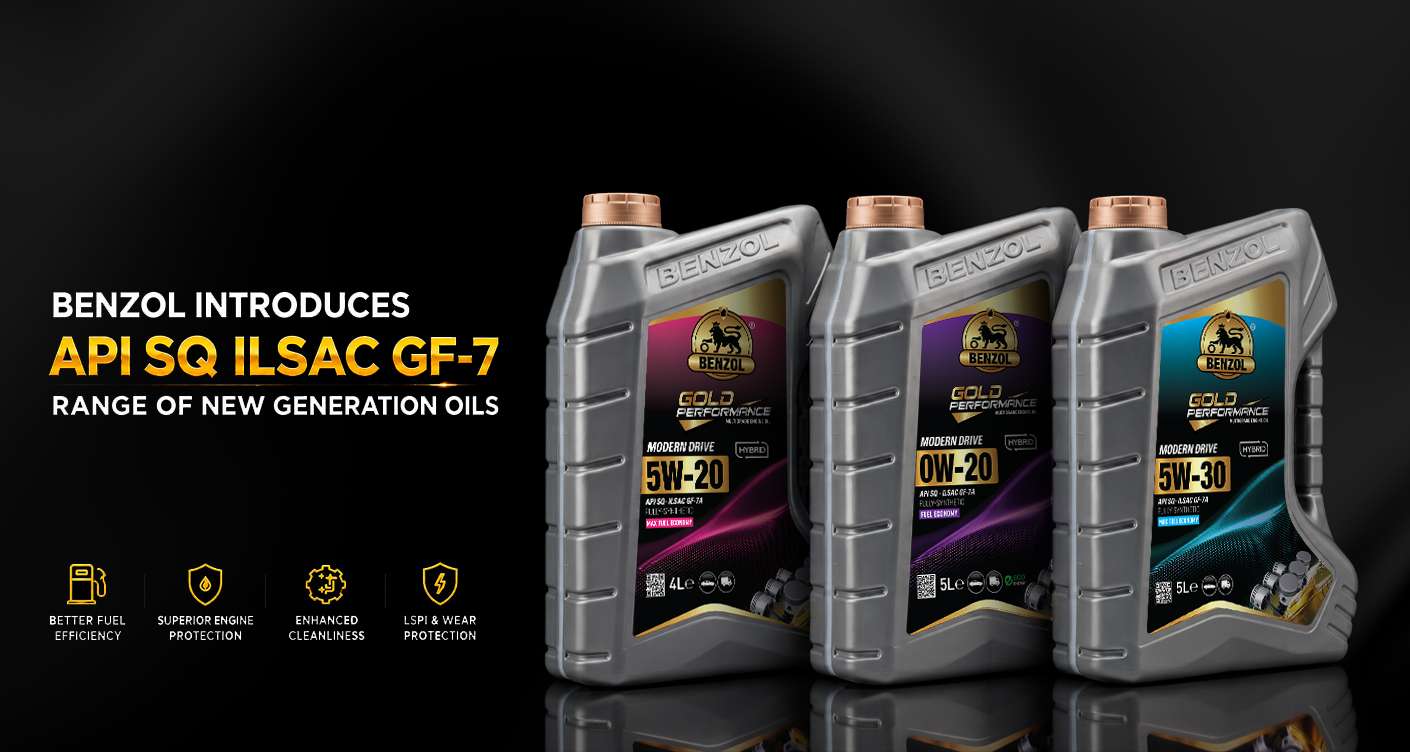
At Benzol, we did not wait for the market to catch up. Our Modern Drive range already includes seven API SQ certified grades, all developed and produced to German engineering standards. This article explains what API SQ actually means, how it compares to the previous API SP standard, and which Benzol products carry the new certification.
1. What Is API SQ? A Plain-Language Explanation
API stands for the American Petroleum Institute, the organisation responsible for setting and updating engine oil performance standards for gasoline-powered passenger cars. Every few years, as engine technology advances, API raises the bar with a new service category. The series runs alphabetically: API SN, API SP, and now API SQ.
API SQ officially entered into force on March 31, 2025, replacing API SP (which launched in 2020) as the current performance benchmark for modern passenger car petrol engine oils. It was developed in parallel with the ILSAC GF-7 standard published by the International Lubricants Standardization and Approval Committee – the two are closely aligned, with API SQ being the slightly broader specification that also covers ultra-low viscosity grades not included in GF-7.
In simple terms: API SQ is the newest, most advanced standard for petrol engine oils. If your vehicle was manufactured in the last five years – especially if it has a turbocharged, direct-injection, or hybrid powertrain – an API SQ rated oil delivers better protection than any older standard.
2. How API SQ Improves on API SP: The Key Differences
API SP was already a strong specification when it launched, particularly for controlling Low-Speed Pre-Ignition (LSPI) – a damaging combustion event in turbocharged GDI engines. API SQ builds on that foundation and goes further in five important ways.
Enhanced LSPI Protection on Aged Oil
API SP tested LSPI protection on fresh oil. API SQ introduces an aged-oil LSPI test (Sequence IX), recognising that the risk of LSPI events increases as oil degrades over a service interval. This matters most for high-mileage drivers and those who run longer oil change intervals in GCC conditions.
Stronger Fuel Economy Requirements
API SQ raises the bar on fuel efficiency, requiring oils to demonstrate fuel economy improvement of up to 16% compared to the reference oil used in testing. For drivers in the UAE covering long daily distances or operating commercial vehicles, this translates into measurable savings at the pump over time.
Superior Engine Cleanliness and Deposit Control
The Sequence IIIH test within API SQ sets tighter limits on piston deposits, turbocharger sludge, and varnish formation. Engines in GCC climates operate at consistently high ambient temperatures that accelerate oil oxidation and deposit build-up – making this improvement particularly relevant for UAE and Saudi Arabia driving conditions.
Better Protection for Emissions Systems
API SQ limits sulfated ash content to a maximum of 0.9% by mass. This is important for modern engines equipped with Gasoline Particulate Filters (GPFs), which can become blocked or degraded by high-ash oils. As newer Euro 6 and equivalent vehicles become more common across the GCC market, this protection becomes increasingly important.
Support for Ultra-Low Viscosity Grades
API SQ is the first API category to formally include ultra-low viscosity grades such as SAE 0W-8 and SAE 0W-12 within its scope. These grades are primarily for the latest Japanese and Asian vehicle applications demanding maximum fuel economy. Benzol’s Modern Drive SAE 0W-8 (JASO GLV-1) sits at the leading edge of this direction.
More Rigorous Test Sequences
API SQ incorporates updated versions of the key engine test sequences: Sequence IIH (oxidation and high-temp deposits), Sequence VH (low-temp sludge control), and Sequence VI (fuel economy). Oils must pass all of these to earn the API SQ designation – there are no shortcuts.
3. Is API SQ Backward Compatible?
Yes. API SQ oils are fully backward compatible with all previous API S categories – API SP, SN, SM, and earlier. If your vehicle manual specifies API SP or an older category, an API SQ oil meets and exceeds that requirement. You do not lose anything by moving to API SQ; you only gain the additional protection the newer standard provides.
The only exception to note is ultra-low viscosity grades (0W-8, 0W-12) which are new to API SQ – these should only be used where the vehicle manufacturer specifically requires or permits them.
4. Why API SQ Matters in UAE and GCC Conditions
The GCC presents some of the most demanding conditions any engine oil will face. Ambient temperatures regularly exceed 40°C in summer. Stop-start urban driving in Dubai, Abu Dhabi, and Riyadh creates repeated low-speed high-load cycles – exactly the conditions where LSPI risk is highest. Long highway drives at constant high speed and temperature stress an oil’s thermal stability and oxidation resistance.
Against this backdrop, every improvement API SQ brings – aged-oil LSPI protection, stronger deposit control, higher fuel efficiency, better emissions system compatibility – delivers real benefit to GCC drivers. An oil that just meets API SP may be adequate under moderate conditions; in the GCC, an API SQ oil is the more defensible, future-proofed choice.
5. The Benzol Modern Drive API SQ Range
Benzol’s Modern Drive series is the brand’s flagship fully synthetic passenger car oil line, engineered in Germany to meet the demands of the latest global engine technologies. The following grades within the Modern Drive range carry API SQ certification:
| Viscosity Grade | ILSAC Rating | Primary Application |
| SAE 0W-20 | ILSAC GF-7A | Hybrid & modern petrol engines; ultra-fuel-efficient applications |
| SAE 0W-30 | ILSAC GF-7A | High-efficiency modern petrol engines; cold-climate start-up |
| SAE 5W-20 | ILSAC GF-7A | Modern petrol cars; fuel economy focus; Asian & American market specs |
| SAE 5W-30 | ILSAC GF-7A | Broad-application modern petrol; turbocharged & GDI engines |
| SAE 5W-40 | — | High-performance petrol & light diesel; European turbocharged engines |
| SAE 10W-30 | ILSAC GF-7A | Warmer climate all-rounder; fleet & older modern petrol engines |
| SAE 10W-40 | — | Semi-warm climate; high-mileage petrol & light commercial engines |
All API SQ grades within the Modern Drive range are produced under Benzol’s quality management system, which holds EELQMS (European Engine Lubricant Quality Management System), ISO 9001-2015, ISO 14001-2015, and ISO 45001-2018 accreditations. The range is also certified to ACEA and API standards and is available across the UAE, Saudi Arabia, and wider GCC markets.
🔎 Advisory: For exact product specifications, viscosity grades, and full certification details within the Benzol API SQ range, visit the Benzol Oil Finder and refer to each individual product page on benzollubricants.de for complete approval listings and performance data.
6. Which Benzol API SQ Grade Is Right for Your Vehicle?
The correct grade depends on your vehicle manufacturer’s specification, your engine type, and your operating conditions. As a general guide:
- SAE 0W-20 or 0W-30 API SQ / ILSAC GF-7A – ideal for newer petrol hybrid vehicles and engines requiring ultra-low viscosity for maximum fuel economy, where the manufacturer specifies these grades.
- SAE 5W-20 or 5W-30 API SQ / ILSAC GF-7A – the broadest application grades; suitable for a wide range of modern petrol cars including turbocharged and GDI engines where API SQ / GF-7 performance is required.
- SAE 5W-40 API SQ – suited to higher-performance petrol engines and light commercial petrol applications operating in elevated GCC temperatures.
- SAE 10W-30 API SQ / ILSAC GF-7A – a practical all-rounder for fleet and commercial operators in warmer climates who require the API SQ performance tier.
- SAE 10W-40 API SQ – for high-mileage petrol engines and those operating in very warm ambient conditions where a slightly higher viscosity at operating temperature is appropriate.
Always refer to your vehicle owner’s manual for the manufacturer’s recommended oil specification before selecting a product. Use the Benzol Oil Finder to identify the exact matching grade for your vehicle.
7. API SQ and ILSAC GF-7: Understanding the Relationship
API SQ and ILSAC GF-7 are closely related but not identical. ILSAC GF-7 was developed jointly by American and Japanese automotive manufacturers and specifically covers viscosity grades from SAE 0W-16 upward. It is subdivided into GF-7A (backward compatible with GF-6A, covering most common grades) and GF-7B (for SAE 0W-16 specifically).
API SQ is the broader API counterpart: it covers everything ILSAC GF-7 covers, plus additional viscosity grades outside GF-7’s scope such as SAE 0W-8, 0W-12, and grades without a Resource Conserving requirement. An oil certified to ILSAC GF-7A or GF-7B also meets API SQ requirements. An API SQ oil is not necessarily GF-7 certified (for example, a 5W-40 grade would be API SQ but outside GF-7’s viscosity scope).
In the Benzol Modern Drive range, grades marked API SQ / ILSAC GF-7A carry both certifications. Grades marked simply API SQ (such as 5W-40 and 10W-40) carry the API SQ certification without the GF-7 co-certification, in line with the standard’s viscosity scope.
8. A Quick Comparison: API SN vs. API SP vs. API SQ
For those working through older vehicles or mixed fleets, here is a straightforward summary of the three most recent API service categories:
| Feature | API SN (2010) | API SP (2020) | API SQ (2025) |
| LSPI Protection | None | Yes – fresh oil | Yes – fresh & aged oil |
| Fuel Economy Test | Basic | Improved | Up to 16% improvement |
| Deposit Control | Standard | Enhanced | Tightest limits to date |
| GPF Compatibility | No specification | Partial | Ash limit ≤0.9% max |
| Ultra-Low Viscosity | No | No | Yes (0W-8, 0W-12) |
| Backward Compatible | Yes | Yes (covers SN) | Yes (covers SP, SN) |
9. FAQs: API SQ Engine Oil
What does API SQ mean on an engine oil bottle?
API SQ is the latest performance classification issued by the American Petroleum Institute for petrol engine oils. It replaced API SP in March 2025 and indicates the oil meets enhanced standards for LSPI protection, fuel economy, engine cleanliness, emissions system compatibility, and timing chain wear protection.
Is API SQ better than API SP?
Yes. API SQ builds directly on API SP and improves it in every key area: stronger protection against LSPI in aged oil, higher fuel efficiency requirements, tighter limits on deposits and sludge, and better compatibility with modern emissions systems such as Gasoline Particulate Filters. API SQ is the current top-tier standard.
Can I use API SQ oil in a car that specifies API SP?
Yes. API SQ is fully backward compatible with API SP, SN, and earlier categories. Using an API SQ oil in a vehicle that specifies API SP or older is perfectly correct and gives the engine the benefit of the newer, more advanced formulation.
Does Benzol have API SQ certified engine oils?
Yes. Benzol’s Modern Drive range includes seven API SQ certified grades: SAE 0W-20, 0W-30, 5W-20, and 5W-30 (all API SQ / ILSAC GF-7A), plus SAE 5W-40, 10W-30 (API SQ / ILSAC GF-7A), and 10W-40 (API SQ). Use the Benzol Oil Finder at benzol.lubricantadvisor.com to identify the right grade for your vehicle.
What is ILSAC GF-7 and how does it relate to API SQ?
ILSAC GF-7 is the companion standard to API SQ, developed jointly by American and Japanese automakers. GF-7A covers most common viscosity grades and is designed to be backward compatible with older GF standards. An oil certified to ILSAC GF-7A also satisfies API SQ requirements. The two standards were introduced simultaneously in 2025.
Is API SQ engine oil suitable for turbocharged cars in UAE?
Yes, and it is particularly well-suited. Turbocharged GDI engines are precisely the application API SQ was developed to address – with enhanced LSPI protection on aged oil, better deposit control on turbocharger components, and higher fuel efficiency performance. In the UAE’s high-temperature operating conditions, these improvements deliver real-world benefits.
Which API SQ grade is best for UAE conditions?
For most modern petrol cars in the UAE, SAE 5W-30 API SQ / ILSAC GF-7A is a practical starting point – but always check your vehicle owner’s manual first. Owners of newer hybrid or fuel-economy-focused vehicles may require 0W-20 or 5W-20. For higher-performance engines or commercial applications, 5W-40 or 10W-40 API SQ may be appropriate. Use the Benzol Oil Finder to confirm the correct grade for your specific vehicle.
How do I know if my car needs API SQ?
Check your vehicle owner’s manual – look for a recommended API service category. If your manual specifies API SP or earlier, API SQ oil meets and exceeds that requirement. If your manual specifies API SQ specifically (as newer 2025+ vehicles may), then API SQ is required.
Benzol Modern Drive API SQ – Available Across UAE and GCC
Benzol’s Modern Drive API SQ range is available through authorised Benzol distributors, workshops, and retail partners across the UAE and Saudi Arabia. Whether you are an individual driver looking for the most current engine protection, a fleet manager specifying oils for a modern vehicle portfolio, or a workshop owner seeking a reliable API SQ manufacturer or supplier, Benzol delivers.
- Seven API SQ certified grades covering the full viscosity range for modern petrol engines
- ILSAC GF-7A co-certification on five grades
- Manufactured under EELQMS, ISO 9001, ISO 14001, and ISO 45001 quality systems
- ACEA, API, JASO, and ECAS certified
- OEM approvals from Mercedes-Benz, Volkswagen, Renault, Volvo, MAN, Caterpillar, and Mack
- Available through Benzol’s UAE and GCC distribution network
Contact Benzol today or use the Oil Finder at benzol to identify the right API SQ grade for your vehicle or fleet.